
Connected Recovery for CJR-X: Making the 90-Day Episode Visible
Two complementary views of home recovery — knee motion plus foot loading — for hospitals getting ready for mandatory CJR-X.
Why now
On January 1, 2028, the Comprehensive Care for Joint Replacement Expanded (CJR-X) model becomes mandatory for most eligible hospitals nationwide. Hip, knee, and ankle replacement episodes — inpatient and outpatient — will be reconciled against a regional target price across the full 90 days after discharge. And quality comes first: a hospital must meet a minimum composite quality score before it can receive reconciliation payments at all.
The composite reflects complications after elective primary total hip or knee arthroplasty, hospital visits within seven days of outpatient surgery, two patient-experience measures, and the hip/knee patient-reported outcome performance measure.
The operational implication is simple: a completed surgery is only the beginning. Hospitals need a dependable way to see whether a patient is moving, exercising, loading the limb appropriately — and drifting from the expected pathway — between visits.
90 days, 5 measures, 2 signals
Connected rehabilitation can't change a CMS quality score by itself. But it can make the 90-day episode more visible, actionable, and accountable — and that's where programs win or lose.
Sensoria's approach pairs two complementary signals:
Signal 1: Knee motion (smart brace or sleeve). The Sensoria Smart Knee Brace captures knee range of motion, activity, and exercise adherence, with guided at-home exercises for the patient and remote access for clinicians. The design opportunity is flexibility: the connected layer works across different textile sleeves and rigid braces, so patients aren't forced into a single form factor.
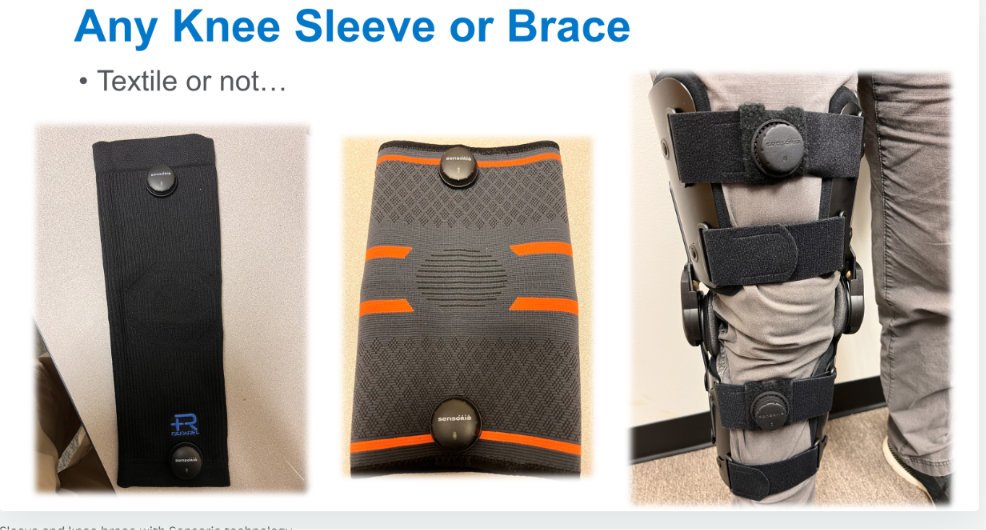
Sensoria smart knee / sleeve options available
Signal 2: Foot loading (Sensoria Socks). Knee range of motion says how the joint moves. Plantar-pressure and gait signals add context about how the patient actually uses the limb during standing and walking. Sensoria Sock 2.0 carries three textile pressure sensors under the plantar surface and reports impact, cadence, and foot-landing technique. A 2025 gait study found strong agreement for gait-cycle time and cadence against a reference inertial system.
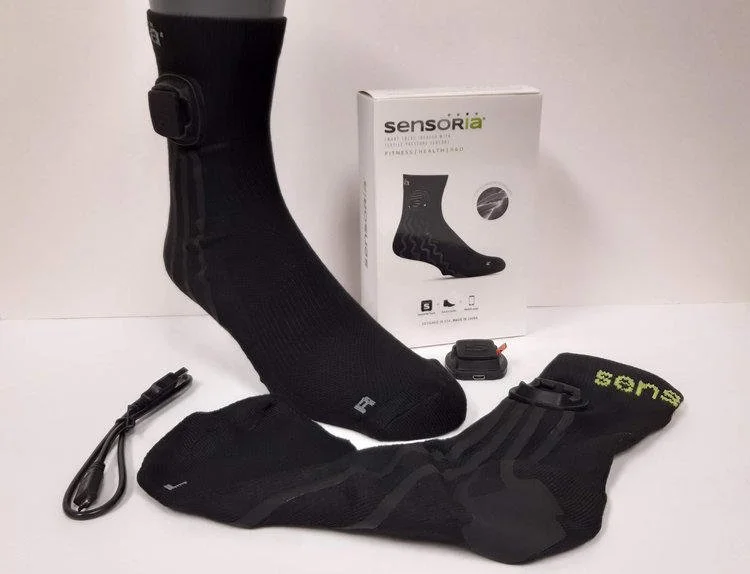
Sensoria smart socks + Sensoria Core microelectronics
Together, the two signals help distinguish "not doing the exercises" from "doing them, but protecting the surgical side" — an interpretation that remains a clinical hypothesis until the care team reviews it, but a far richer starting point than a pain score alone.
From data to action: detect, contextualize, escalate
Data becomes useful when it drives a defined response. The proposed workflow links the wearable, the patient mobile experience, cloud services, and the clinician dashboard — and designs alerts around care-team decisions, not notification volume:
Detect — a mobility, activity, or adherence signal crosses a clinician-defined threshold.
Contextualize — the patient is asked concise questions about pain, medication, and barriers.
Escalate — the care team reviews the trend and follows an approved triage protocol.
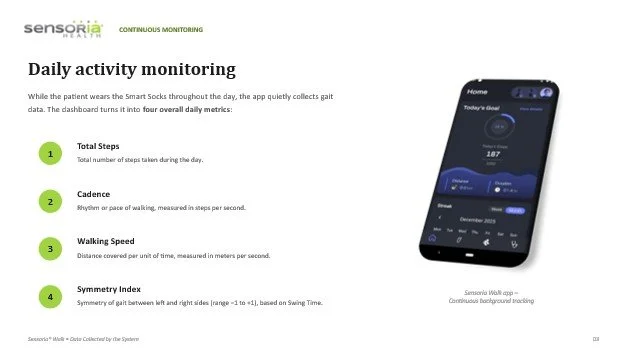
Sensoria Walk Companion App for Gait Mobility
Agentic AI can organize outreach and highlight exceptions — but it should not diagnose, prescribe, or autonomously change a rehabilitation plan. Escalation thresholds, message wording, and response ownership need clinical approval.
Just as important: use a recovery playbook, not a wall of notifications. Missed exercises get automated reminders; plateauing motion or persistent loading asymmetry get therapist review; concerning pain responses or sudden functional decline get rapid escalation. And keep the denominator visible — enrolled patients, patients transmitting usable data, alerts reviewed, interventions completed — so apparent improvement can't just be missing data.
Start with a pilot, not a promise
A focused 60- to 90-day pilot can establish whether the combined brace-and-sock workflow produces usable data, timely intervention, and acceptable patient burden. Suggested design: a defined total knee arthroplasty cohort, follow through the 90-day episode, with clear inclusion criteria, onboarding support for patients with limited digital access, documented escalation ownership, and a historical or concurrent usual-care comparison where feasible.
Measure four kinds of success — feasibility, workflow, clinical process, and episode outcomes — and set decision gates: continue if data completeness and clinician use meet the threshold, modify if alerts are noisy or engagement is low, and scale only after a credible link between the workflow and better outcomes.
The bottom line
CJR-X rewards coordinated, quality-conscious episode management. Wearable technology can make home recovery more observable — but the value comes from pairing that visibility with validated measures, clear escalation rules, and accountable clinical action.
Is your program CJR-X-ready? 2027 is the year to prepare.