
CMS’s New IPPS Rule Reshapes Joint Replacement Economics
CMS Just Reshaped the Economics of Joint Replacement
Recently, CMS quietly released one of the most consequential policy proposals the orthopedic sector has seen in years. Beneath the headline 2.4% Inpatient Improved Payment System (IPPS) rate increase—roughly $1.4B in additional hospital funding—was a structural shift that will redefine how total joint arthroplasty is evaluated, reimbursed, and managed.
CMS is proposing the Comprehensive Care for Joint Replacement – Expanded (CJRX) model, a return to—and expansion of—bundled care. Total joint arthroplasty would once again fall under a 90‑day, two‑sided risk framework, making hospitals accountable for the entire episode of care, not just the surgery.
And that fundamentally changes the economics of joint repair.
The Return of “Two‑Loop” Economics
For years, the orthopedic industry optimized around the surgical loop:
implants
alignment
robotics
surgical technique
But the financial risk doesn’t live inside the operating room. It lives in the second loop—the one dominated by:
emergency department (ED) visits
readmissions
downstream medical complications
“This is the loop that determines whether a hospital earns a bonus or pays a penalty under CJRX.” This is the loop CMS is now explicitly incentivizing hospitals to manage.
The question is no longer “What implant do you use?” It’s “What keeps my patients out of the hospital?”
CMS Is Funding Post‑Op Visibility
To make this shift possible, CMS added two major incentives:
1. Up to $1,000 per patient for postoperative technology
This is a direct signal that continuous monitoring, adherence tracking, and early‑intervention tools are now part of the standard of care.
2. $464M in New Technology Add‑On Payments (NTAP) for breakthrough‑designated devices
This accelerates adoption of technologies that extend care into the home and detect complications before they escalate.
The message is clear:
If you can’t see the patient after they leave the hospital, you can’t manage cost. And if you can’t manage cost, you will be punished.
The Economics of Avoiding a $10–11K Readmission
Under CJRX, the math is simple:
Meet spending and quality metrics → performance bonus
Miss the targets → repay CMS for all costs above the benchmark
With average readmissions costing $10,000–$11,000, preventing even a few materially shifts a hospital’s financial performance.
This is why downstream complications—not surgical ones—are the financial center of gravity.
Real‑World Evidence: What Happens When You Extend Care Beyond the Hospital
In a real‑world dataset comparing 1,719 Persona IQ TKAs to 8,594 controls shows the economic impact of continuous postoperative visibility:
ED visits: 14.9% → 8.1%
Readmissions: 8.8% → 4.3%
Orthopedic complications: reduced
Mean 90‑day savings: $5,739 per case
These are the types of outcomes CMS is now directly incentivizing. Technologies that reduce downstream utilization will move from “nice to have” to essential.
As CMS strengthens incentives around full‑episode performance, hospitals increasingly rely on sensor‑enabled tools such as smart sleeves to capture continuous, real‑world recovery data. These devices provide objective ROM and mobility metrics that help clinicians intervene earlier, reduce complications, and document functional improvement—key drivers of reimbursement under the updated IPPS rule.
What Smart Sleeves Do for TKA Patients
Smart sleeves typically integrate inertial measurement units (IMUs), accelerometers, gyroscopes, and pressure or strain sensors to continuously capture postoperative mobility metrics such as range of motion (ROM), gait patterns, weight‑bearing, and adherence to home exercise programs. These devices stream data to mobile apps or clinician dashboards, enabling remote monitoring and early detection of recovery deviations
Introducing the Sensoria Smart Knee Brace System (SKB) Sensor‑enabled monitoring that works with virtually any knee brace / sleeve
To align with clinical reality—where most TKA patients are not placed in rigid, hard‑sided braces—the Sensoria solution is repositioned as a Smart Knee Brace System, not a brace itself.
The SKB System is a sensor‑enabled, soft‑goods‑agnostic monitoring platform that can be paired with:
standard postoperative knee sleeves
soft braces
hinged braces
or a hospital’s existing knee‑support devices
This ensures compatibility with typical TKA protocols while delivering continuous, objective postoperative visibility.
What the SKB System Is and Why It Matters Under CJRX
The SKB System is designed to give clinicians continuous, objective visibility into a patient’s recovery after total knee arthroplasty. Unlike traditional braces or sleeves that provide only mechanical support, the SKB System functions as a remote mobility and recovery‑monitoring platform, capturing the very metrics CMS is now incentivizing hospitals to manage under the CJRX 90‑day episode.
Core Capabilities of the SKB System
Embedded motion sensors capture knee flexion/extension, step count, cadence, stance time, and mobility patterns.
Continuous, real‑time data streaming provides visibility into recovery trajectories—not just snapshots during clinic visits.
Deviation‑detection algorithms flag early signs of:
reduced mobility
asymmetric loading
compensatory movement patterns
slowed recovery curves
Adherence monitoring tracks device usage and exercise participation.
Lightweight, soft‑goods‑compatible design ensures comfort and high patient compliance.
Seamless integration with Sensoria’s clinician dashboard for remote monitoring.
What the SKB System Measures
The brace integrates textile-embedded sensors and a lightweight motion unit to continuously capture
Gait quality
Knee range of motion
Functional mobility trends (adherence to rehab)
Deviation from expected recovery trajectory
These are the same indicators that predict ED visits, readmissions, and postoperative complications—the financial center of gravity in a two‑sided risk bundle.
What SKB Does for Clinicians and Hospitals
The SKB is designed to extend clinical oversight beyond the hospital walls, giving care teams the ability to:
See recovery in real time, not just at follow‑up visits
Detect early warning signs—reduced mobility, asymmetric loading, abnormal gait patterns
Intervene proactively before a deviation becomes an ED visit or readmission
Monitor adherence to prescribed rehab activity
Stratify risk across the 90‑day episode using objective, continuous data
Document recovery trends for quality reporting and episode‑based reimbursement
In other words, the SKB operationalizes the exact behaviors CMS is now rewarding: visibility, early detection, and downstream complication prevention.
Why This Matters in a 90-Day, Two-Sided Risk World
Under CJRX, hospitals are no longer evaluated on how well the surgery went—they’re evaluated on what happens after the patient goes home. The SKB directly addresses the blind spot CMS is now financially targeting:
“If you can’t see the patient after they leave the hospital, you can’t manage cost.”
The SKB closes that visibility gap by turning the patient’s daily mobility into a continuous clinical signal. It gives hospitals the ability to manage the second loop—the loop that determines whether they earn a bonus or pay a penalty.
The SKB as a CMS-Aligned Technology
The proposed rule explicitly funds technologies that:
extend care into the home
support adherence
detect complications early
reduce ED visits and readmissions
provide objective, continuous monitoring
The SKB checks every box.
It is precisely the type of postoperative technology CMS is signaling with the $1,000 per‑patient tech allowance and the $464M NTAP allocation for breakthrough devices. Hospitals preparing for CJRX will need tools that deliver measurable reductions in downstream utilization. The SKB was built for that environment.
Where Sensoria Health Fits into This New Landscape
If CMS is shifting the economics toward full‑episode accountability, hospitals will need tools that:
monitor patients continuously
detect deviations early
reduce ED visits and readmissions
support adherence and recovery
integrate seamlessly into clinical workflows
This is exactly the gap Sensoria Health’s Smart Knee Brace (SKB) was designed to fill.
The SKB provides continuous, objective, real‑time gait and mobility data—the very metrics that correlate with downstream complications and 90‑day episode cost. It gives clinicians visibility into recovery trajectories, flags deviations early, and supports proactive intervention.
For hospitals preparing for CJR‑X, this is the type of technology CMS is explicitly funding.
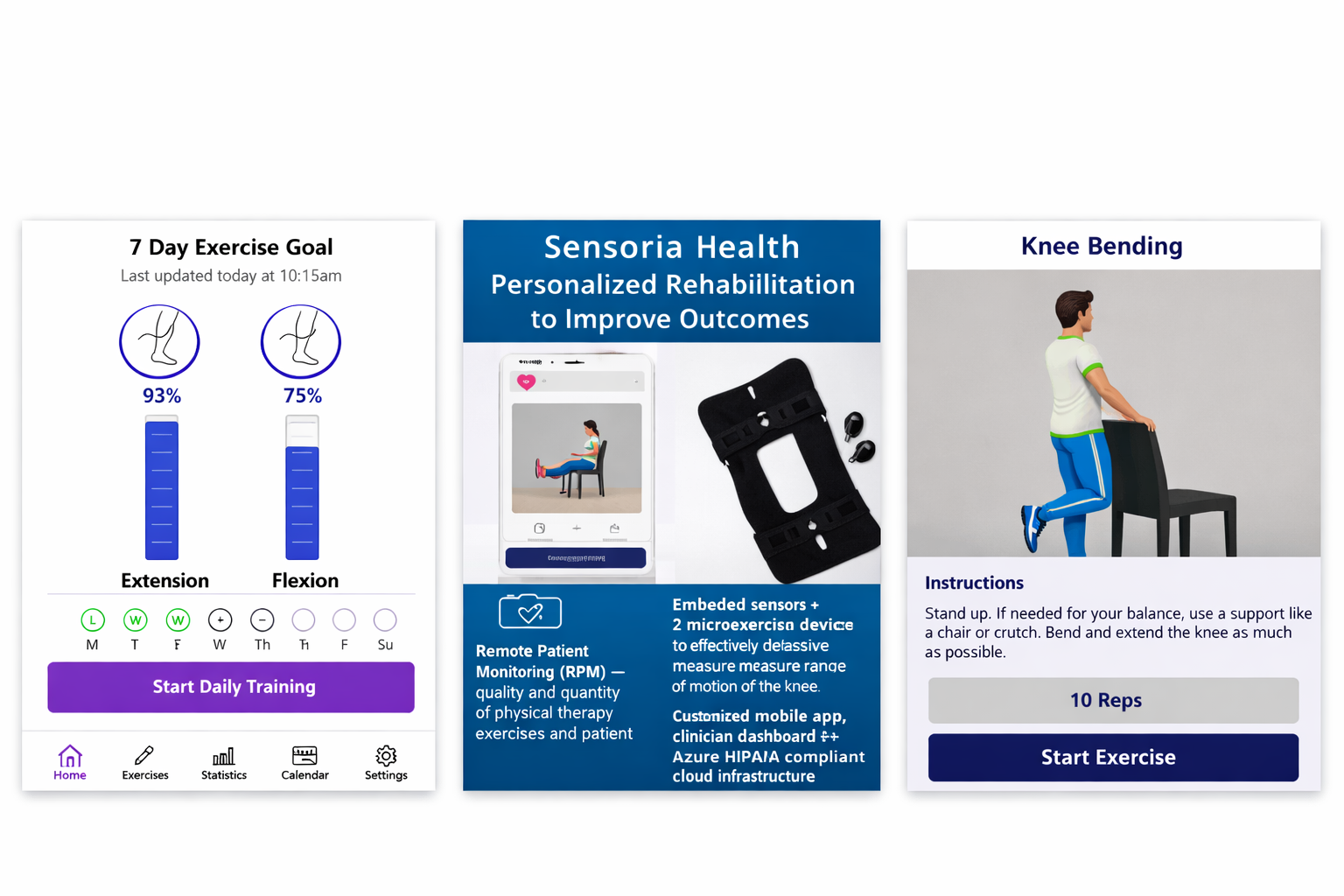
The SKB mobile app is designed as the digital layer of the Smart Knee Brace system—turning the brace’s embedded textile sensors and motion analytics into actionable, real‑time rehabilitation guidance for both patients and clinicians. It functions as a full remote patient monitoring (RPM) companion, enabling continuous oversight of knee‑rehab progress outside the clinic.
The 19 Prescribed Exercises Included in the App
The SKB Companion App includes a structured library of 19 clinically validated exercises designed specifically for TKA recovery. These exercises target:
knee flexion
knee extension
quadriceps activation
gait normalization
balance and proprioception
progressive strengthening
How the App Uses These Exercises
Exercises are prescribed by the clinician (customizable) and delivered automatically.
The brace provides real‑time motion data to confirm completion and quality.
The app adapts based on patient performance and recovery trajectory.
Clinicians can monitor adherence and adjust the plan remotely.
This creates a closed‑loop recovery system — exactly what CMS is incentivizing with its postoperative technology allowance.
Key Capabilities (Patient-Facing)
· Patients follow the exercise plan prescribed by their physical therapist.
· Each exercise includes structured instructions, rep counts, and pacing guidance
· The app monitors every repetition, capturing both quantity and quality.
Real-Time Feedback Loop
Using the brace’s embedded sensors, the app provides instant feedback on:
Range of motion
Movement quality
Repetition accuracy
Compensatory patterns
This helps patients correct form immediately, reducing risk of poor technique.
Daily Progress Tracking
· Patients see their adherence, completed exercises, and improvement trends.
· Encourages engagement and supports long-term recovery compliance.
Clinician-Facing Value
Remote Patient Monitoring (RPM)
Clinicians can remotely review:
Exercise adherence
Quality-of-movement metrics
Daily/weekly progress
Enables proactive intervention when patients deviate from expected recovery.
Objective, Sensor-Derived Metrics
Provides quantifiable data on knee mobility and functional recovery.
Supports evidence-based decision-making and personalized care adjustments.
Streamlined Workflow Integration
Designed to complement existing PT workflows.
Reduces guesswork by replacing subjective patient self-reporting with objective sensor data
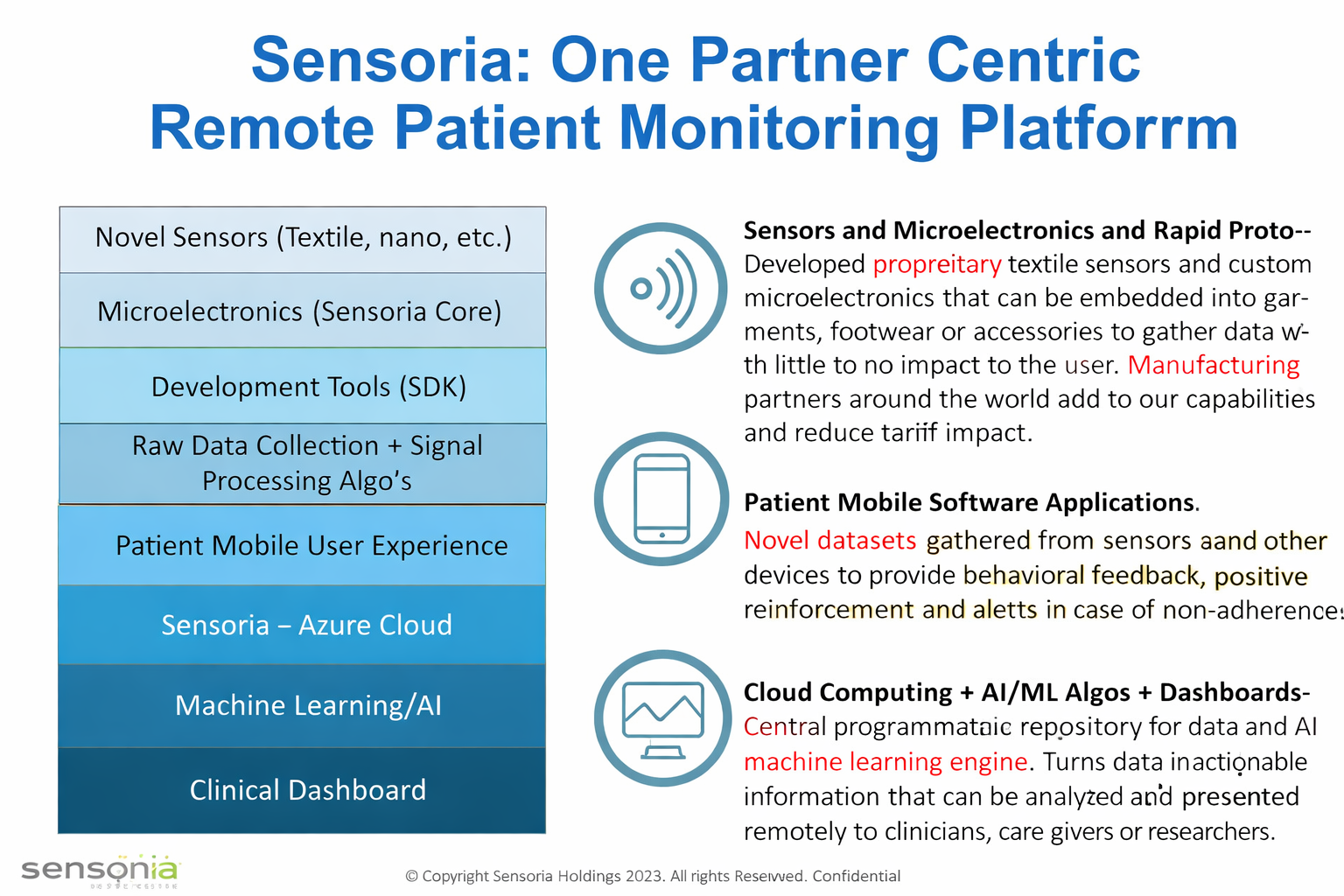
How It Fits into Sensoria’s Platform
The SKB app is part of Sensoria’s broader sensor-to-cloud ecosystem, aligning with your clinical-minimalist, evidence-driven brand voice:
Smart Knee Brace → SKB App → Sensoria Cloud
Enables multi-condition monitoring across ortho, rehab, and post-surgical pathways.
Integrates seamlessly with Sensoria’s other wearables (Smart Socks, Smart Boot, etc.) for a unified mobility analytics platform.
Explore the Sensoria Smart Knee Brace here: https://start.sensoria.io/skb
A Structural Shift Toward Full‑Episode Value
The proposed IPPS rule is more than a reimbursement update. It is a reorientation of incentives toward:
Full episode accountability
Proactive complication detection
Remote monitoring
Digital recovery pathways
Technologies that extend care beyond the hospital walls
For orthopedics, this is a watershed moment. The economics of joint replacement have officially moved outside the OR.
Hospitals that invest in visibility, adherence, and early intervention will thrive under CJR‑X. Those that continue optimizing only the surgical loop will find themselves exposed.
The future of joint replacement is not just about how well the surgery goes.It’s about what happens next.